AI song generator: how it works and which tool to use
An AI song generator turns a short description or your own lyrics into a finished song with vocals in a minute or two. Several well-known tools have a free tier, but free usually means personal use only.
songfy editorial team, Nautigo GmbH · Published
How an AI song generator works
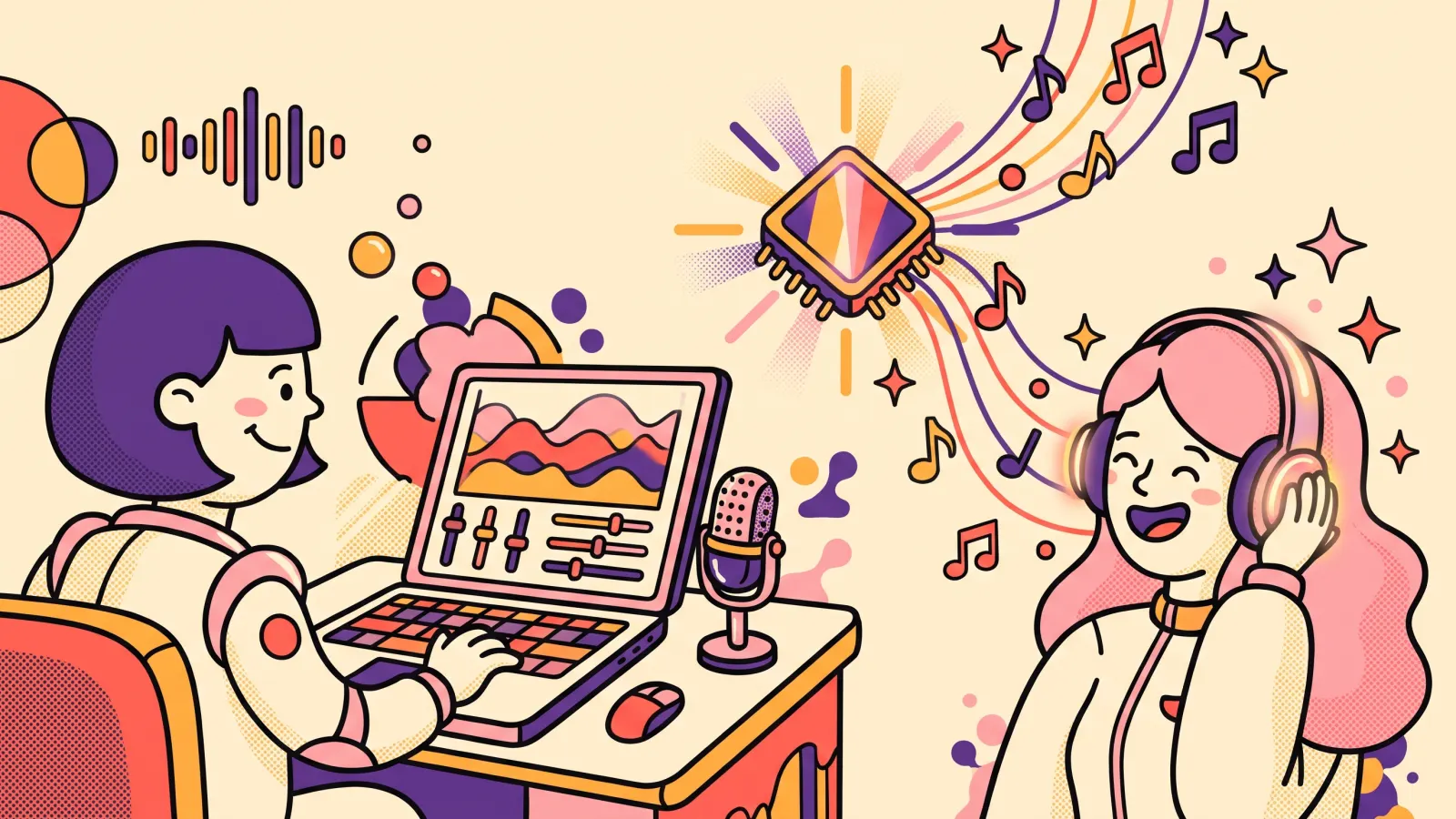
Most generators combine two parts. A language model writes the lyrics, or takes the ones you paste in. A music model turns them into melody, accompaniment and a sung performance. Some tools show both in one window, others split it into two steps.
Your influence sits in the prompt: what the song is about, the style (pop, rock, country), whether a female voice, a male voice or a duet sings, and the mood. The model does not follow this note by note. It draws on patterns it learned in training, so the same prompt gives a different song every time.
That explains two things beginners notice. The result sounds polished fast but is hard to steer precisely. And names or rare words are sometimes pronounced wrong, because the model has never heard them in that context.
AI music generators compared (as of November 2026)
The search results for this topic are tool pages and “best tools” lists. The table below sticks to well-known providers and to what could be checked on their own pages or in reliable reporting. Prices and rules change often, so check them before you rely on them.
| Tool | Free tier? | What you get | Licensing and commercial use |
|---|---|---|---|
| Suno | Yes, 50 credits a day, but no downloads | Full songs with vocals from a prompt or your own lyrics. Free model v6-mini, paid plans v6 and v6-wild. | Free is personal only and cannot be downloaded. Pro (from $10 a month, $8 billed yearly) and Premier allow commercial use, with a monthly download cap. |
| Udio | Limited, reportedly a few credits | Songs with vocals from text. In a walled garden since the October 2025 deal with Universal. | As far as we could verify, downloads are currently unavailable, and reports in late September said the new licensed platform had not launched. Check the official site. |
| Google Gemini (Lyria 3.5) | Yes, reportedly with usage limits | Since 4 September 2026 available to all Gemini users in the app and on the web: songs with vocals, genre and vocal choice. Every track carries a SynthID watermark. | We found no clear statement on commercial use. Check Google's terms. |
| ElevenLabs Music | Yes, 10,000 credits a month | Music from a text description, part of the ElevenLabs platform. | Music commercial use is listed from the Starter plan ($6 a month), not on the free plan. |
Many smaller sites sit on top of someone else's model. For those, their own terms count, not the terms of the model behind them.
What changed in licensing in 2025 and 2026
The major record labels sued Suno and Udio in 2024 over training on protected recordings. Since then a lot has moved, but not everything is settled.
- Udio settled with Universal on 29 October 2025 and is building a licensed platform. Creations stay in a protected environment.
- Suno settled with Warner in November 2025 and released its licensed v6 model family on 9 September 2026. Universal and Sony sued Suno again shortly after in Massachusetts, and those cases are ongoing.
- On 31 July 2026 the Munich Regional Court I largely sided with the German collecting society GEMA against Suno (case 42 O 763/25). It concerned six well-known songs the model could reproduce. The ruling is not final.
For an individual user this mostly means that provider rules move fast and features such as downloads can change. If you need a song for the long term, save it right away and keep a copy of the terms from the day you made it.
How to get a good AI song, step by step
- Decide the occasion and the listener. A song for a mother's birthday needs different words than a party track.
- Pick genre and voice on purpose. Soft acoustic pop carries personal lyrics better than fast rock. Choose a female, male or duet voice.
- Write down real details. The place you met, a phrase they say all the time, a nickname. These make a lyric unmistakable. Generic words like “love” and “happiness” come for free from any model.
- Bring your own lyrics if you can. Many tools accept them. Short lines with a clear rhyme work best.
- Spell tricky names the way they sound. Write “Yo-HAN-uh” instead of “Johanna” and listen to that spot in the result.
- Listen to several versions. Generate two or three and keep the one where words and mood fit. Read the lyrics aloud at the end.
If you do not want to fine-tune prompts, our guide to a custom song made for someone compares the routes. And if the song is a present, see the guide to a birthday song with a name.
Who owns an AI song?
This is not legal advice, but the picture is fairly clear. In the United States, the Copyright Office concluded in its report on copyrightability of 29 January 2025 that, with current technology, a prompt alone does not make you the author of the output. Parts you write yourself, such as your own lyrics, can still be protected, and so can human edits and arrangement.
Germany points the same way: copyright protects only personal intellectual creations (section 2(2) of the German Copyright Act), which means a human author. A song a model makes from a short description is therefore not automatically protected.
What you may do with the song is a separate question, and it is set by the provider's terms, not by copyright law. For the tools checked here, commercial use usually comes only with a paid plan. On labeling, Article 50 of the EU AI Act has applied since 2 August 2026 and requires providers to mark AI-generated content in a machine-readable way. For systems already on the market, the agreed Digital Omnibus moves that marking duty to 2 December 2026. The duty mainly falls on providers, not private users.
Where songfy fits: a song as a gift
songfy is not a general song generator. There is no prompt box and no download quota. Instead you tell us who the song is for, give a name, the occasion and real memories (about three minutes), choose one of eight styles and a female, male or duet voice. Lyrics and music are made with AI (Google Gemini and Lyria), in 14 singing languages.
You can read the lyrics before the music is done, and the preview is free. You pay only afterwards, once, $59, with no account. Private and social media use is allowed, commercial use is not. If you need music for ads or streaming, one of the tools above with the right plan is the better fit.
Listen to an example
You can create the song here, or browse more ideas in our guide to a gift for someone who has everything.
Frequently asked questions
Can I make a song with AI for free?
Yes, several tools have a free tier with daily or monthly credits. At Suno, for example, the free plan currently has no downloads, and commercial use is only allowed on paid plans.
Can I put an AI song on Spotify?
It depends on the tool and the plan. For the providers checked here, commercial use needs a paid plan, and distributors often ask you to disclose that the song is AI-generated.
Who owns the copyright to an AI song?
In the US and Germany, copyright protects only human authorship, and a prompt alone is not enough under current views. What you may do with the song is set by the provider's terms.